


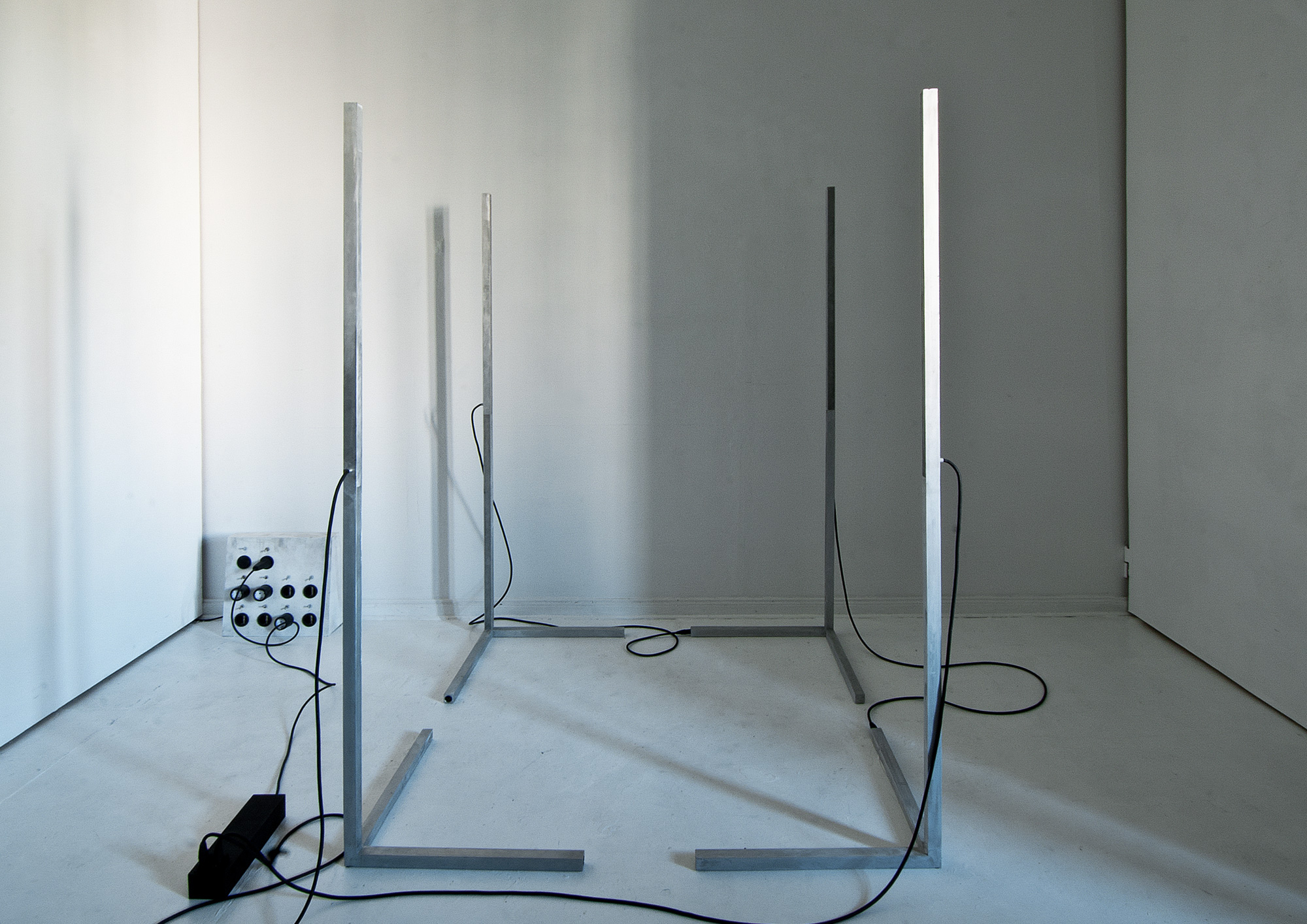
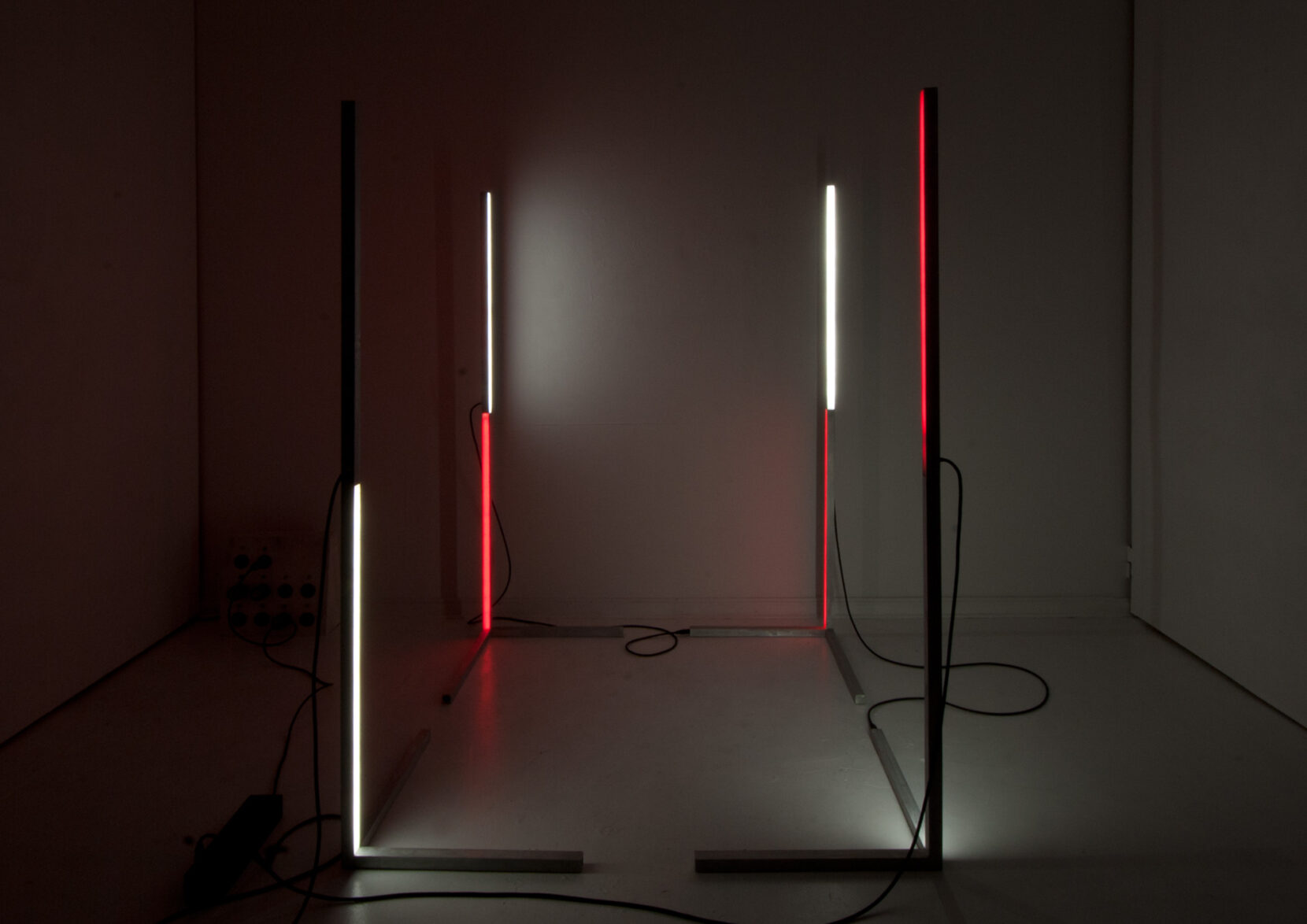
my home is my castle (2019) aluminium, resin, recycled glass, led (each 54 x 54 x 180cm)

Hannah Arendt: The right to privacy is the right not to be seen.
Michel Foucault: Space is fundamental to every form of power.
Space is not merely an extension or physical reality, but an existential condition of human existence. As a dwelling and free space, it forms the fundamental prerequisite for humans to be able to locate themselves in the world. In this sense, living does not only mean occupying a place, but being in the world itself: having a place from which the world can be experienced and in which permanence, protection and orientation are condensed.
As a private retreat, space opens up the possibility of distancing oneself from the outside world. Only through this distance does freedom become conceivable. Freedom is not merely the absence of coercion, but the ability to escape the grasp of others. One’s own space creates a sphere in which the subject can encounter itself, unobserved, unjudged and thus autonomous. In a society based on visibility and exchange, private space is the necessary counter-space in which individuality can emerge and exist.
At the same time, space is always a form of positioning. Those who occupy space assert their existence. This assertion is never neutral, but rather an act of declaration: here I am, here I reside, from here I speak. Space thus becomes an extension of the self, a spatial manifestation of identity. The way in which space is used, structured or defended articulates the subject’s relationship to the world.
As property, space takes on an additional symbolic dimension. It becomes a sign of belonging, power and social location. Ownership of space means not only disposal, but also visibility in the fabric of other spaces. Self-expression through space is always relational: one’s own space gains meaning in comparison to neighbouring, public or foreign spaces. This makes space a medium of social communication in which values, hierarchies and lifestyles become legible.
Ultimately, space is always also a boundary. It separates inside and outside, the familiar and the foreign, belonging and exclusion. This demarcation is necessary to stabilise identity, but at the same time harbours the potential for exclusion. Space marks who has access and who remains excluded. This marking function shows that space not only offers protection, but also exercises power.
Space thus appears as an ambivalent structure: it enables freedom and limits it at the same time, protecting the subject and confronting it with the other. Space is therefore not merely a backdrop to human action, but a constitutive element of human existence.
The lines of light function as minimal markings of ownership, positioning and demarcation.
Light replaces solidity and points to the fact that space is created less by material than by social, symbolic and powerful settings.They assert a private space without completely shielding it.
This makes the ambivalence of space tangible: it is at once a place of retreat and an exposed structure, protection and assertion, freedom and limitation.The changeable position wide/narrow reflects and manifests one’s own claim to space, its meaning and one’s own social location.
Related topics: boundaries / demarcation
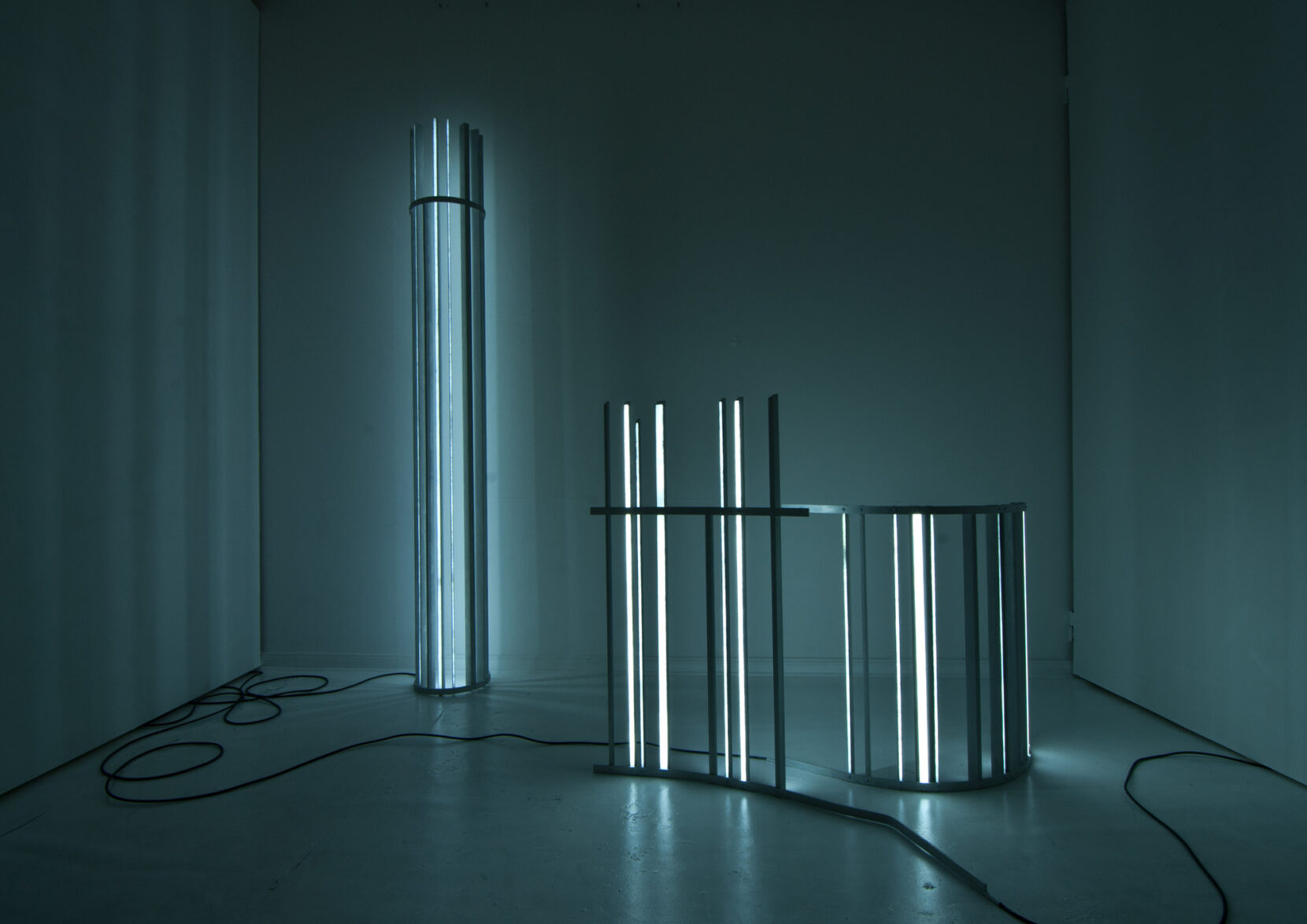
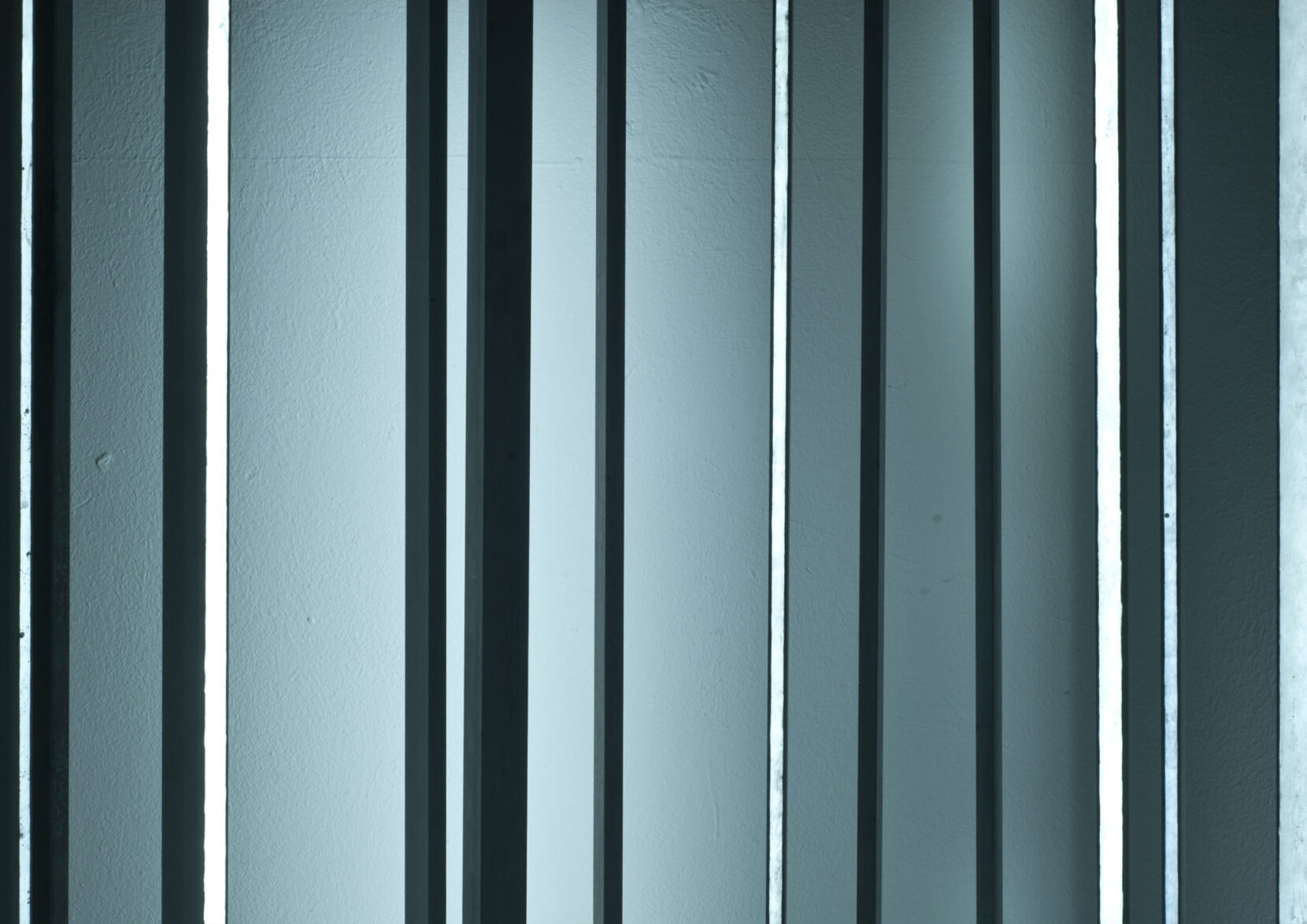
coded fence
(2019) aluminum, resin, recycled glass, led (100 x 85 x 5/38 cm / 127 x 118 x 5/34 cm / 35 x 252 x24 cm)
Hannah Arendt: Das Recht, privat zu sein, ist das Recht, nicht gesehen zu werden.
Michel Foucault: Der Raum ist grundlegend in jeder Form von Machtausübung.
Raum ist nicht lediglich Ausdehnung oder physische Gegebenheit, sondern eine existentielle Bedingung menschlichen Seins. Als Wohnung und Freiraum bildet er die grundlegende Voraussetzung dafür, dass der Mensch sich in der Welt verorten kann. Wohnen bedeutet in diesem Sinne nicht nur das Besetzen eines Ortes, sondern das In-der-Welt-Sein selbst: einen Ort zu haben, von dem aus die Welt erfahrbar wird und in dem sich Dauer, Schutz und Orientierung verdichten.
Als privater Rückzugsort eröffnet Raum die Möglichkeit zur Distanzierung vom Außen. Erst durch diese Distanz wird Freiheit denkbar. Freiheit ist nicht allein die Abwesenheit von Zwang, sondern die Fähigkeit, sich dem Zugriff des Anderen zu entziehen. Der eigene Raum schafft eine Sphäre, in der das Subjekt sich selbst begegnen kann, unbeobachtet, unbewertet und damit autonom. In einer Gesellschaft, die auf Sichtbarkeit und Austausch beruht, ist der private Raum der notwendige Gegenraum, in dem Individualität entstehen und bestehen kann.
Zugleich ist Raum immer eine Form der Positionierung. Wer Raum einnimmt, behauptet Existenz. Diese Behauptung ist nie neutral, sondern ein Akt der Setzung: Hier bin ich, hier halte ich mich auf, von hier aus spreche ich. Raum wird so zur Verlängerung des Selbst, zur räumlichen Manifestation von Identität. In der Art, wie Raum genutzt, strukturiert oder verteidigt wird, artikuliert sich das Verhältnis des Subjekts zur Welt.
Als Besitz erhält Raum eine zusätzliche symbolische Dimension. Er wird zum Zeichen von Zugehörigkeit, Macht und sozialer Verortung. Besitz an Raum bedeutet nicht nur Verfügung, sondern auch Sichtbarkeit im Gefüge anderer Räume. Die Selbstdarstellung über Raum geschieht stets relational: Der eigene Raum gewinnt Bedeutung im Vergleich zu benachbarten, öffentlichen oder fremden Räumen. Dadurch wird Raum zu einem Medium sozialer Kommunikation, in dem Werte, Hierarchien und Lebensentwürfe lesbar werden.
Schließlich ist Raum immer auch Grenze. Er trennt Innen und Außen, Eigenes und Fremdes, Zugehörigkeit und Ausschluss. Diese Abgrenzung ist notwendig, um Identität zu stabilisieren, birgt jedoch zugleich das Potenzial der Ausgrenzung. Raum markiert, wer Zugang hat und wer ausgeschlossen bleibt. In dieser markierenden Funktion zeigt sich, dass Raum nicht nur Schutz bietet, sondern auch Macht ausübt.
So erscheint der Raum als Wohnung und Freiraum als ambivalente Struktur: Er ermöglicht Freiheit und begrenzt sie zugleich, schützt das Subjekt und konfrontiert es mit dem Anderen. Raum ist damit kein bloßer Hintergrund menschlichen Handelns, sondern ein konstitutives Moment menschlicher Existenz.
Die Lichtlinien fungieren als minimale Markierungen von Besitz, Positionierung und Abgrenzung.
Das Licht ersetzt das Massive und verweist darauf, dass Raum weniger durch Material als durch soziale, symbolische und machtvolle Setzungen entsteht. Sie behaupten einen privaten Raum, ohne ihn vollständig abzuschirmen.
Dadurch wird die Ambivalenz von Raum erfahrbar: Er ist zugleich Rückzugsort und exponierte Struktur, Schutz und Behauptung, Freiheit und Begrenzung.Durch die veränderbare Stellung weit/eng wird der eigene Anspruch auf den Raum sowie dessen Bedeutung und die eigene soziale Verortung reflektiert aber auch manifestiert.